The engines
A log that thinks.
The right engine turns a log into something that coaches you. The wrong one turns every session into a guess. Plate Daddy ships four, lets you mix them, and adapts all of them to real life.
Pick one before you train
Four flavors of "what comes next?"
Progressive Overload
Nudges weight and reps up as you complete work. Bench 135×5 last week becomes 140×5 today. Hit your targets and it advances; miss and it holds. Free for your first 180 days, then part of Pro.
Power Matrix
The same seven-set pyramid every workout, with the loads computed for you. Structure you can feel session to session. Pro.
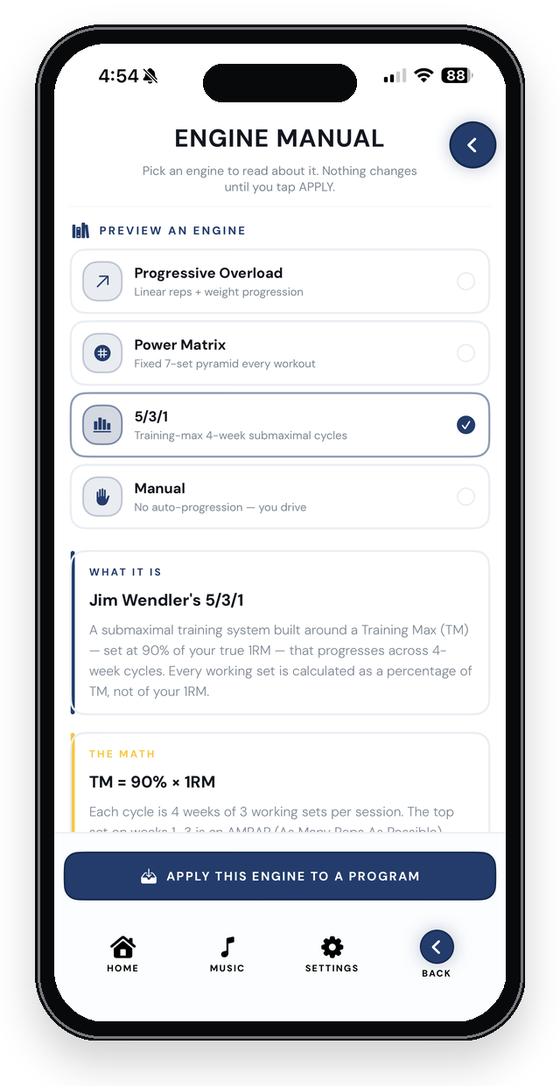
5/3/1
Jim Wendler's system: a Training Max set at 90% of your true 1RM, four-week cycles, every working set a percentage of the TM, and an AMRAP top set in weeks 1–3. The percentages are done for you; you just show up and hit the AMRAP. Pro.
Manual
No auto-progression. Last session shows in gray so you can see it; you decide what today is. Always free.
Hierarchy
Set it once. Override anywhere.
Settings establishes a default engine, a program can override it, a day can refine it, and an individual exercise can still use its own rule set. Most of your workout on Progressive Overload, but bench press wants 5/3/1? Override just that one.
Settings
What new workouts inherit by default. Set it once so you're not picking the same engine over and over.
Program
A strength block on 5/3/1, a hypertrophy block on Progressive Overload. The program carries its own default.
Day
Heavy day on Power Matrix, pump day on PO. Refine per session without touching the program.
Exercise
Bind an engine to a single movement from its progression sheet. Everything else stays as it was.
An engine that adapts
Machines run out of plates. Some days the reps aren't there.
Progression engines love adding weight, but the cable stack tops out at 200, and some nights set three just doesn't have eight reps in it. Instead of pretending otherwise, the app adapts. No spreadsheet thinking required; it's automatic.
Machine caps
Hit the top weight? Progress moves into reps, then sets.
- Tap the MAX pill on the active workout, or set Max Weight in the exercise's progression sheet.
- Reps first. The engine stops pushing weight and starts working reps, up to 25.
- Then sets. At 25 reps it adds a set, all the way to 10 sets.
- Caps don't move by accident. Log a weight above the cap and the app double-checks. Confirming means typing the machine's new max yourself.
500 lb × 22 · 3 sets
Recovery mode
Miss your reps? Next session holds the weight while you rebuild.
- One rep at a time. The weight holds and one rep is added to your weakest set each session, until you hit the full range. Then the weight moves again.
- The plan, up front. When a session starts in recovery mode, a popup tells you: today is about getting the reps in, not chasing weight.
- Reps are just lifting. Bumping the WEIGHT past the engine's plan gets a respectful are-you-sure. Adjusting reps up or down never does.
- Trust the process. The manual-advancement disclaimer only appears for an exercise that has a prior session of the same day to progress from, never on a first-ever entry.
185 lb × 8
185 lb × 8
185 lb × 7 → 8 (rebuilding)
Everything else the engine sees
Warmups, RPE, AMRAP, day-scoped history.
- Warmup sets are marked as warmups so they don't pollute PRs or volume, or the next target.
- RPE per set with an override picker, so a grinder and a cruise don't look the same in history.
- AMRAP top sets on 5/3/1 get their own banner and feed the next cycle.
- Day-scoped history. Progression applies to the lifts you performed on that specific day, so Push A and Push B don't fight each other.
- Edit last session from the LAST TIME card if a number went in wrong. The engine recalculates.
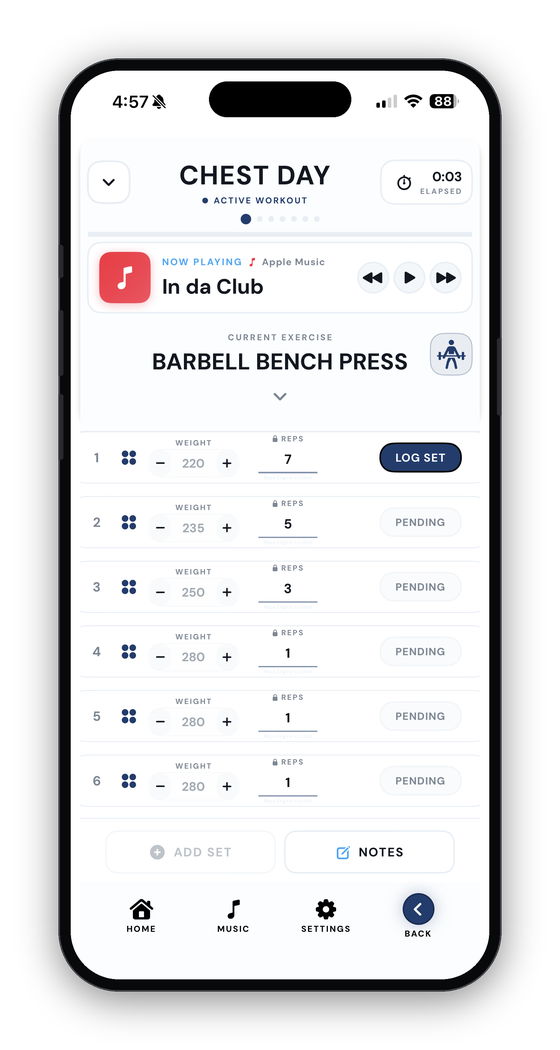
Plate math
Nobody wants to do plate math at rep ten.
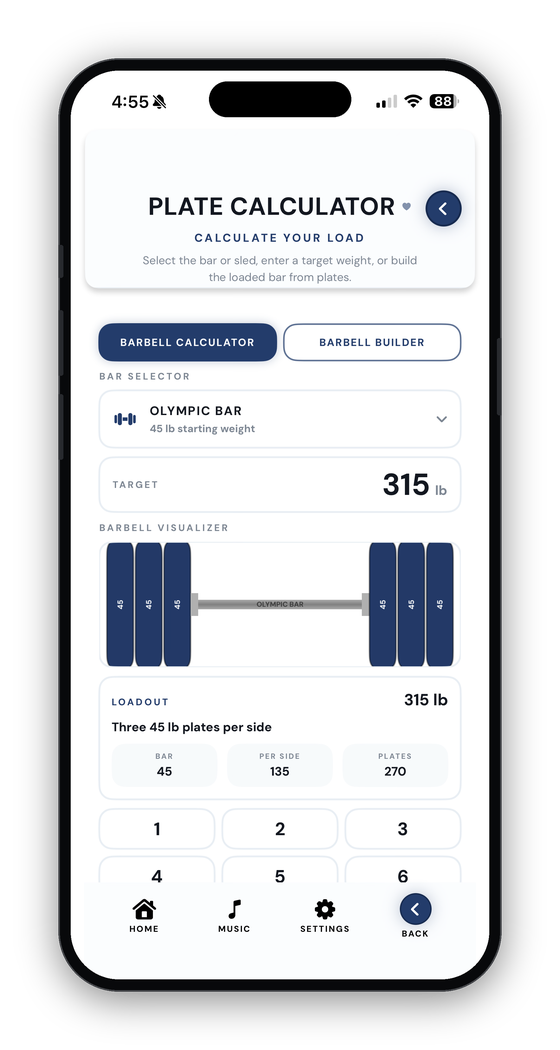
Between Smith machines, curl bars, kilo plates, leg press sleds and that one specialty bar your gym keeps in the corner, bar math is annoying. The calculator handles all of it. There's a full version on Home and a tiny one right inside the set row.
- Target in, plates out. Type a number; it picks the plates and tells you exactly what to load on each side.
- Build the bar. Stack plates by hand and watch the total climb. Handy when you're staring at someone else's loaded bar.
- Real bar weights. Smith, trap, curl and safety squat bars don't weigh 45. Set what they actually weigh.
- Sled base weight. The leg press has weight before you add a plate. Tell the calculator and your numbers stay honest.